
Paweł Blicharz

Research engineer · Gdańsk, Poland

I'm a research engineer at Animatica, where I train generative models that animate 3D characters.

My research is in mechanistic interpretability. I take trained networks apart to find which parts cause a behaviour, and test that they really do. What I'd like most is for that understanding to change how we train models, not only describe them. I also have a soft spot for reinforcement learning, where I started.

I studied Data Engineering at Gdańsk University of Technology, and for a while led Gradient PG, the university's deep learning club.

Paweł Blicharz

Research

I like causal methods (sparse probing, activation patching, ablations) because they turn "the model seems to use X" into a claim you can try to break.

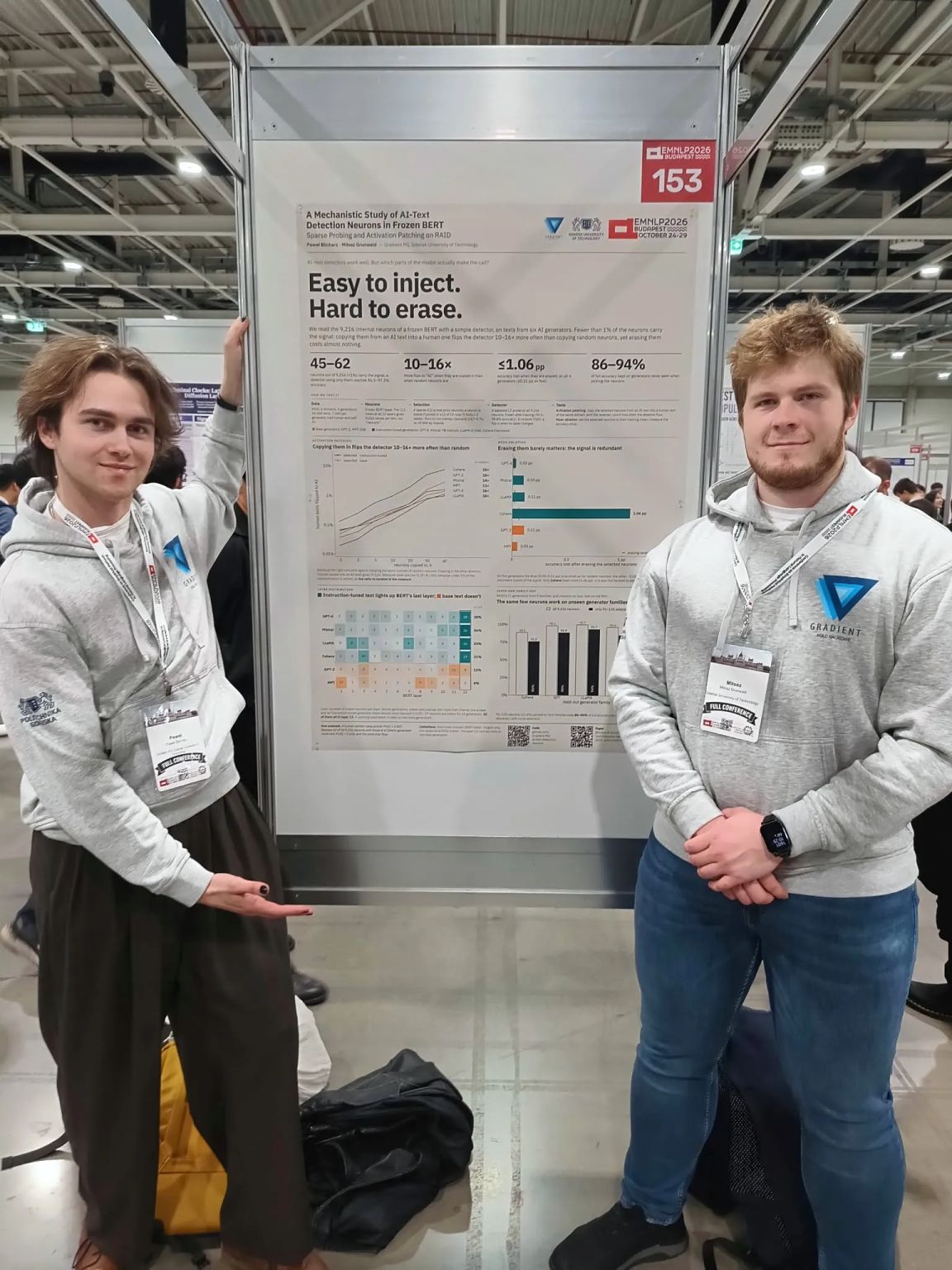
Paweł Blicharz and Miłosz Grunwald next to their poster at EMNLP 2026
With Miłosz at our poster, EMNLP 2026 in Budapest.

EMNLP 2026 · Main conference

A Mechanistic Study of AI-Text Detection Neurons in Frozen BERT: Sparse Probing and Activation Patching on RAID

Paweł Blicharz, Miłosz Grunwald

Where does a frozen BERT keep the difference between human and AI text? Out of 9,216 neurons, a stable set of 45 to 62 is enough for near-ceiling detection. Copying them into human text flips the detector 10 to 16 times more often than random neurons, while erasing them costs almost nothing. Easy to inject, hard to erase.
Projects

Obelus

A paper reader for pen or keyboard. Circle a passage, write in the margin, and the note links itself to the exact words, equations and figures it's about. Everything is saved as plain files that your tools and AI agents can read. Free and open source, for Windows and Linux.

Warehouse bot

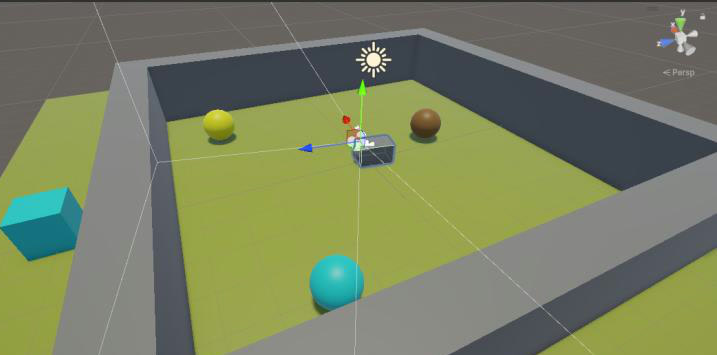
My thesis agent. It sees the room through a 120° camera, is told which item is wanted, and has to find it and bring it to the deposit. PPO and a curiosity bonus written from scratch in PyTorch, trained in Unity with a curriculum.

The training room in Unity: walled floor, coloured balls as items, the agent in the middle
The training room in Unity. The box outside the wall shows which item is wanted.

autoresearcher

An autonomous researcher for ML codebases. You write down falsifiable questions and a scoring rubric; it starts one agent per question, and each one explores the code, runs experiments and scores its own results until it finds something significant. You wake up to a findings report. It runs on Claude Code, Cursor or Codex, coordinated only through markdown files.

You questions to test + a scoring rubric program.md starts one agent per question Agent 1 explore → experiment → score ↻ Agent 2 explore → experiment → score ↻ Agent 3 explore → experiment → score ↻ until score ≥ 7 or out of budget findings.md results counterarguments follow-ups papers/ PDFs → short notes

Experience

Education & community

Outside work

I'm starting a series of explainer videos on what happens inside AI models. I run, train at home, and keep a slightly over-engineered system of notes and flashcards for everything I read.